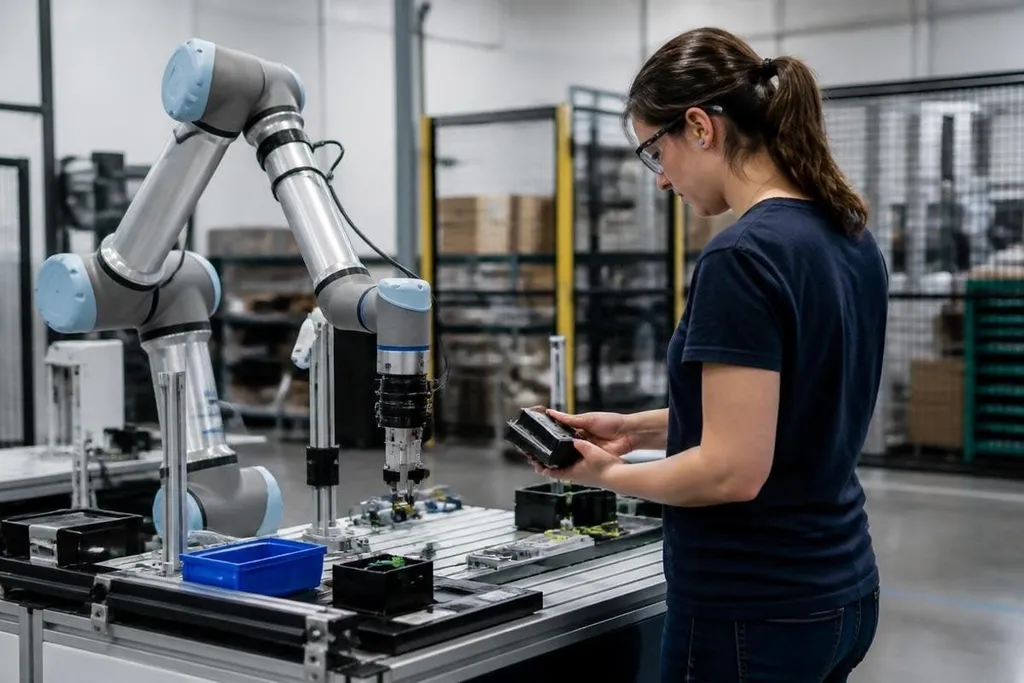
A collaborative robot that works safely beside a person still has to fit the whole job. The next wave of cobots will be judged by handoff time, task changes, safety data, and the cost of putting them into a real work cell.
- Useful work: pick, place, inspect, or assemble without constant human correction
- Safe contact: detect a person, tool, or changed load before contact becomes harmful
- Fast changeovers: move between tasks without a long programming project
The arm is only one part of the job
A cobot is a robot arm built to work near people under defined safety conditions. That arm still needs a gripper, cameras or other sensors, a control system, a work surface, and a clear task plan.
Many cobots use six axes, which let the arm turn and reach from several directions. Six axes don't solve every handling problem. A soft bag, a reflective part, or a bin that shifts by a few millimeters can still cause a failed pickup.
That is why future cobots need better sensing at the tool and better checks before each motion. Force and torque sensors can tell the controller that the gripper met resistance. Vision can locate a part, but the system still needs rules for what to do when the part is partly hidden or out of position.
Safety has to fit the full work cell
A safety rating on the arm doesn't cover every hazard around it. The gripper, part, fixture, cables, nearby machinery, and the person's movement all affect the risk assessment.
ISO 10218 sets safety requirements for industrial robots and robot systems. ISO/TS 15066 adds guidance for collaborative operation, including contact limits for people and robots. Those documents help teams plan a safe setup, but they don't turn a risky task into a safe one by themselves.
Buyers need clearer safety data for the complete application. A buyer needs to know what changes when the cobot carries a sharp part, uses a fast gripper, or works beside a machine with its own moving parts.
A short demonstration with an empty gripper answers very little.
The missing detail is the task: a cobot may repeat a handoff well in one cell and fail when the part, fixture, or worker changes. Use Robot24.com to find reports that name the cobot, task, work site, and test result. Those details show whether the claim came from the arm or from a carefully arranged demo, which is where programming needs to start.
Programming should start with the task
Many cobot systems use graphical programming, hand-guided teaching, or software built on tools such as ROS 2. These methods can shorten setup for a trained technician, but a short program does not guarantee a stable process.
The system needs clear recovery steps. If a part is missing, the gripper should stop in a known position. If a person enters the work area, the robot should slow or stop under the site's safety rules. After the stop, the operator needs a clear way to inspect the part and restart the task.
Task changes matter just as much. A factory that makes small batches may change parts each day, so the useful measure is the time from a new part arriving to a repeatable cycle. Vendors should report that time with the fixture, gripper, software, and training included.
What buyers should ask for
A new cobot may have better motors or a smaller control box. Those details matter less than proof that the full setup works on the job you need to run. Use this check before approving a purchase:
- Name the task: record the part size, surface, weight, cycle time, and allowed error
- Request the full cell: include the gripper, fixture, camera, safety parts, software, and training
- Test bad cases: remove a part, shift its position, change the load, and stop the robot during a cycle
- Measure changeover: time setup for a new part from fixture change to repeatable production
- Check service terms: ask who fixes the arm, gripper, sensors, and control software when one fails
A vendor demo can show that a cobot completes one task. The buying decision needs evidence that the same setup recovers from ordinary mistakes, meets the site's safety plan, and can be changed without specialist help. I'd wait for that proof before paying for a wider rollout.